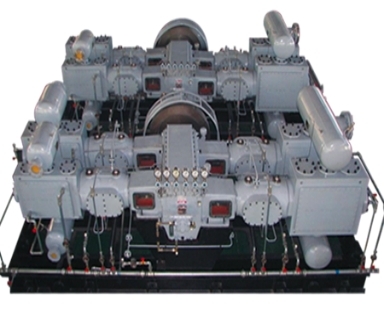
What inlet and discharge pressure ranges can the piston booster achieve?
Our standard piston boosters accept inlet pressure from 0 to 1.0 MPa(g), with adjustable discharge pressure between 1.0 and 3.0 MPa(g). We can customise 1–6 compression stages for special pressure ratios, perfectly matching the outlet parameters of methanol reforming systems and hydrogen generator equipment.
Does the piston booster require constant on-site operator supervision?
No continuous manual supervision is needed. The PLC automatic control system supports real-time fault alerts and safety interlock shutdown, enabling long-term unattended operation for green hydrogen plant and industrial hydrogen projects. Your in-house staff can complete routine preventive maintenance following the official operation manual.
Can we tailor the flow and staging configuration to match our exact hydrogen boosting demand?
Yes. Flow displacement can be set between 5 and 200 Nm³/min, with flexible 1–6 compression stages. Single unit or parallel multi-skid layouts are available to meet the throughput and pressurisation requirements of hydrogen production plant and Green Hydrogen Production Plant.
What are the key differences between oil-free piston boosters and diaphragm compressors for low-medium feed boosting?
Piston boosters deliver larger flow volume with lower procurement cost for medium-pressure compression, and compression stages can be flexibly adjusted to adapt to variable inlet pressure. Diaphragm compressors are suitable for ultra-high pressure (32 MPa and above) and ultra-high purity scenarios, while piston boosters act as cost-effective front-end pre-compression equipment for large-scale methanol reforming hydrogen production workshops. Our technical team will analyse total ownership cost to recommend the most suitable compression solution.
How complex is site installation of the piston booster unit?
All skid-mounted units are pre-assembled, pre-piped, pre-instrumented and pre-wired at the factory. Installation and commissioning of a single skid can be finished within 3–7 working days. We provide full construction supervision, equipment calibration and operator training for projects supporting hydrogen gas generator.
What noise level does the piston booster generate during continuous operation?
Balanced crankshaft design plus acoustic enclosure reduces noise to below 75 dBA at a 1-metre distance, complying with industrial noise standards for indoor and semi-outdoor installation within green hydrogen plant.
Where can I find the complete maintenance schedule for the booster compressor?
The official Operation & Maintenance Manual records detailed periodic inspection cycles, wearing part replacement plans and full preventive maintenance procedures. Minor inspections are arranged monthly, while major overhaul for pistons and valves only needs to be carried out every several years under rated continuous working conditions for industrial hydrogen production.